
The Psychology of Shared Bathrooms
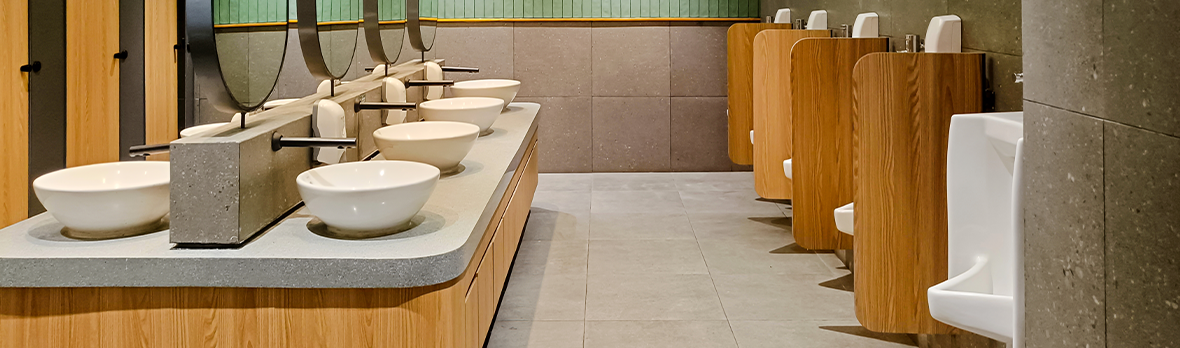
There are plenty of jokes related to shared bathrooms and the way we behave in them. However, they are often based on patterns of behaviour that perhaps all of us follow. So how does human psychology work when it comes to shared bathrooms?
One thing is the subconscious feelings that each of us goes through when we visit a shared bathroom. The other is data gathered from surveys and scientific papers. And they communicate a clear message – there are several rules that most of us follow – consciously or subconsciously – when we visit the bathroom.
Which One Will You Choose?
The moment that appears perhaps most often in various internet jokes and stories is the way in which we choose a urinal or cubicle in a shared bathroom. When this phenomenon was investigated by American researchers who gave people the possibility to make a choice between three empty cubicles, they came up with some interesting results.
The results showed that people’s choices were influenced by more than just availability. Many users had tendencies to avoid the most exposed cubicles and preferred those that offered greater privacy or were further away from areas with frequent movement. Although some earlier studies suggested differences between men and women, researchers now believe that the need for privacy is the key factor behind our choices.

Why privacy matters more than we think
Public restrooms are places where we naturally feel more vulnerable. Psychologists suggest that when using shared toilets, we subconsciously assess several factors, including the level of privacy, cleanliness, and the likelihood of unwanted interaction with other people. As a result, many of us tend to choose cubicles that offer a greater feeling of privacy or are located farther away from the entrance.
Recent research also shows that the design of public restrooms plays a significant role in how comfortable users feel. Factors such as the layout of the space, the positioning of cubicles, visibility, lighting, and overall privacy can influence the user experience, highlighting that well-designed restroom facilities are not only more functional, but also psychologically more satisfying.

How Much Longer?
The difference between men and women was also observed by experts when measuring the time we spend in the restroom – on average, women spend about twice as much time there compared to men.
However, another statistical fact is shared by both women and men – up to 75% of us take our mobile phones to the restroom, and while using the toilet, one in ten of us even use our mobile phones or tablets for shopping.
Toilet Paper
There are also a bunch of interesting facts about our use of toilet paper. For example, did you know that up to twice as many people fold their toilet paper instead of crumpling it? And that women use an average of 7 scraps of paper per toilet visit, while men only use two?

And one last interesting fact – have you ever wondered how it is that when there are two toilet papers in the toilet, they are almost inevitably used at the same time? According to one academic research, two dominant types of human nature are to blame – about half of us will subconsciously choose the larger of the two differently sized rolls when given the choice, while the other half will prefer to spend the smaller one more quickly.
How does the proper placement of cleaning points in production eliminate unnecessary steps for operators?
Efficient production inevitably requires the optimisation of practically everything –...
Show more
How to help employees endure high temperatures and maintain their productivity
The summer months are challenging for employees in many operations. High temperatures reduce concentration, increase fatigue and in some cases they can affect health.
Show more
The struggle to keep tables clean: How to deal with sticky surfaces and wasps on terraces
Is there anything that can ruin an outdoor gathering at...
Show more